

Advice
Choosing limestone, marble or timber fireplace mantels
Compare the character, variation, care and practical design questions behind natural stone and timber fireplace surrounds.
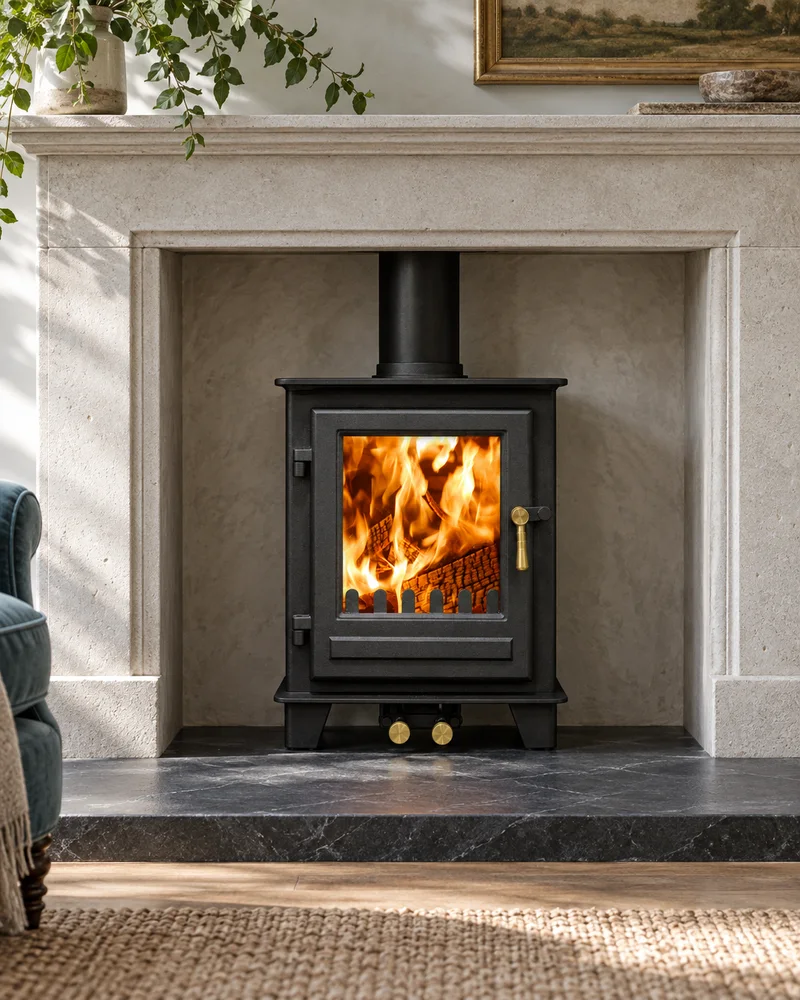
The mantel is often the largest piece of furniture-like architecture in a living room. Its material, width, shelf and opening proportions can make a fireplace feel quiet and integrated or turn it into the main feature. Limestone, marble and timber can all work beautifully, but they do not look, age or need care in the same way.
Choose the material alongside the exact fire, chamber, hearth and room. A sample alone cannot show the finished scale, and a photograph cannot confirm whether a combustible or heat-sensitive element is suitable near a particular appliance.
Compare the whole fireplace first
Before comparing materials, record the practical arrangement:
- the exact fire or stove model;
- the fireplace opening and chamber size;
- the chimney breast width and ceiling height;
- the hearth material and finished dimensions;
- required clearances and non-combustible zones;
- the surround rebate and how it meets the chamber or slips;
- nearby joinery, skirting, sockets and flooring;
- the main viewing positions in the room.
For a combustion appliance, timber and any other combustible material must remain outside the required clearances. Those distances are not a styling preference. They must come from the appliance instructions, the installation design and the applicable requirements. Do not copy a mantel position from an image of a different stove.
Limestone: quiet tone and natural texture
Limestone usually offers a softer, more understated pattern than highly veined marble. Depending on the stone, it can contain small fossils, shells, tonal movement, open grain or natural markings. These details give it character and mean that the finished surround will not be a perfect copy of a small sample.
Limestone often suits rooms where the fireplace should feel established without becoming glossy or highly decorative. Pale neutral stones can work with traditional and modern profiles, while darker or more textured limestones can add weight.
Consider how the surface will be used. Natural limestone is porous and its appearance can change when wet. Classic Mantels advises gentle cleaning with a soft brush, warm water and a non-abrasive cloth or sponge, and warns against acidic or abrasive household cleaners. Confirm the maker’s care instructions for the exact stone and finish rather than applying one routine to every limestone.
Marble: colour, movement and formality
Marble offers a broad range of colours and veins. A quiet pale marble can appear restrained, while strong directional veining can make every section of the surround part of the composition. Think about how the shelf, legs and header will be cut from the slabs and whether the vein direction will be matched or deliberately varied.
The visual effect depends on finish as well as colour. Honed marble reads differently from a highly polished surface, particularly under side light. Take samples into the room at different times of day if possible.
Marble also needs material-appropriate care. Classic Mantels recommends removing dust gently and using a soft cloth with distilled water for routine cleaning, while avoiding acidic or abrasive cleaners. If a mark is persistent, seek advice for the specific marble and finish rather than experimenting on a visible area.
Timber: warmth, colour and a furniture-like feel
Timber introduces grain, warmth and a closer relationship with floors, doors or fitted joinery. Oak, walnut, pine and painted finishes can move the same mantel profile from rustic to formal or contemporary. Natural wood will vary in grain and tone, while stains and paint change how much of that variation remains visible.
Timber also moves and ages. Ask about construction, moisture, finish, likely colour change and how small marks can be repaired. If the surround will be painted, view the proposed sheen and colour beside the wall and hearth rather than choosing from a screen.
Most of all, remember that timber is combustible. Its suitability and position depend on the chosen fire or stove and its required clearances. A timber mantel that works around an electric inset cannot automatically be transferred to a solid-fuel installation.
Other materials and mixed schemes
The choice is not limited to one material throughout. Slate or granite can provide a dark hearth beneath a pale limestone surround. Stone slips can create a suitable transition between the fire opening and a timber mantel where the complete installation permits it. Brick, tile and painted non-combustible surfaces can also form the chamber behind the surround.
Mixed schemes succeed when the junctions are drawn. Decide where each material starts and stops, how thicknesses meet, whether edges are square or profiled and how joints align. A collection of individually attractive samples can look unresolved if these transitions are left until fitting.
The chamber and hearth guide explains those supporting choices in more detail.
Proportion matters as much as material
A mantel should be judged at room scale. The opening, leg width, header height, shelf depth and overall width all affect the result. A tall narrow surround can emphasise ceiling height; a broad low composition can make the room feel wider. The fire should look deliberately framed rather than squeezed into the opening or floating within it.
Make a dimensioned elevation before ordering. Mark the proposed outline on the wall with low-tack tape, including the shelf projection. Check it from the sofa and doorway, and confirm that doors, curtains, radiators and furniture do not create awkward conflicts.
Classic Mantels offers made-to-order fireplaces and multiple natural materials. The Cheshire Stove Shop is an approved Cheshire retailer for the range, with examples in the showroom. Browse the Classic Mantels brand page and the separate limestone, marble and timber collections before comparing physical samples.
Questions to settle before ordering
- Is the material and its position suitable for the exact appliance?
- Which dimensions can be adjusted and which belong to the design?
- What rebate, slips and chamber build-up are required?
- How will the hearth, surround and floor meet?
- What natural variation should be expected?
- Which finish and care instructions apply?
- How will the stone veining or timber grain run across the separate pieces?
- Who is confirming the final site dimensions?
Bring photographs, rough dimensions and examples of the room finishes to the Macclesfield showroom. For a new surround, explain which parts of the fireplace you want to keep and which you want to change when you ask about surrounds and mantels.
Sources checked
General guidance checked on 16 September 2026 against:
- Classic Mantels: marble, limestone and timber materials
- Classic Mantels: cleaning natural stone
- Classic Mantels: Aegean limestone and natural variation
- GOV.UK: Approved Document J for combustion appliances and fuel storage systems
This guide compares design and care considerations. The final material, dimensions, clearances and construction must be checked against the exact appliance, fireplace design, manufacturer information and property.
Continue planning
Related buyer guides
Choosing fireplace chambers and hearths
Plan the opening, chamber lining, hearth material and proportions around the fire or stove, with the technical specification checked for the exact appliance.
02Preparing for a stove and fire showroom visit
Bring the photographs, measurements and property details that turn a showroom visit into a useful shortlist for your home.
03Questions to ask before buying a fire or stove
Use this practical checklist to compare appliances, installation routes, running requirements and the finished fireplace before you commit.
A simple first step
Ask about your room
Tell us what you have in mind. The showroom team will be in touch shortly.
Prefer to talk? Call 01625 402900.